Zhang, S.*, Chen, J.*, Gao, Z., Gao, J., Yi, X., Li, H. (2026). Accepted to CHI2026.
The integration of LLMs into GUI agents promises to revolutionize web browsing automation, yet the practical user experience
remains challenging. This paper systematically characterizes user-reported issues with GUI agents by focusing on three dimensions:
phenomena, influences, and user-centric mitigation.

Chen, J.*, Zhang, M.*, Nie, K.*, Yue, K., Yu, C., Gao, Z., Yang, J., Liang, C., Shi, Y. (2026). Accepted to CHI2026.
Building on prior work in adaptive typography and accessibility, this paper presents SituFont, a LLM-enabled context-aware and human-in-the-loop adaptive typography adjustment approach that enhances smartphone mobile readability by dynamically adjusting font parameters based on real-time contextual changes.

Chen, J.*, Meng Y.*, Nie K. (2026). Accepted to CSCW2026.
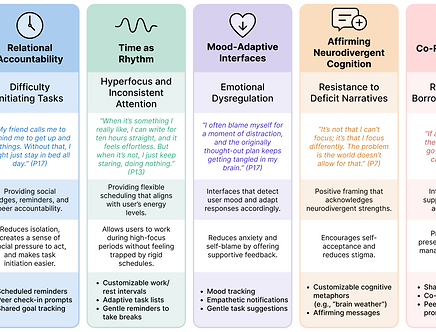
Our findings reveal that task management among adults with ADHD is relationally and affectively co-constructed, rather than an isolated individual act. Overall, we provide empirical insights into distributed and emotionally scaffolded task management practices and design implications for socially-aware AI systems that support co-regulation and nonlinear attention rhythms.
Zhang, S., Ma, Y., Chen, J., Li, S., Yi, X., & Li, H. (2025). Workshop on Human-Centered AI Privacy and Security
(HAIPS) at the 2025 ACM Conference on Computer and Communications Security (CCS 2025).
We propose a conceptual framework built on Contextual Integrity (CI) theory and Privacy Calculus theory, where the agents use alignment and Pareto optimization for aligning preferences and balancing privacy and utility.
Distinguished Paper Award.

J Chen, et al. (2025). Companion Publication of the 2025 Conference on Computer-Supported Cooperative Work and Social Computing.

User research: Enterprise-faced market research for IBM
This project works with IBM to locate the key use cases for enterprise-faced generative AI products and conduct competitor analysis. We compared 12+ competitor products with IBM Watson and came up with actionable recommendations.
Please click the right picture to read the study!

User research: Understanding User Trustworthiness for Google Cloud
This project works with Google cloud, aiming to evaluate the level of “trust” that customers have in GenAI products. We aim to find metrics representing customer “trust” in a GenAI product, how that metric differs across cohorts of customers, and the design factors contributing to that trust through survey data analysis.
Please click the right picture to read the study!

Computational Social Science: SexismViz
This interactive web tool visualizes sexist speech on the Chinese social media platform Sina Weibo. You could explore the posts' distribution across provinces, including their topics and word divergence.
I analyzed the sentiment of each post and established the regression analysis function that allows users to investigate the relationships between various variables freely.
Please click the right picture to access SexismViz!
